
In this article: 3D Skin Mapping Reveals Product Truth.
After years of AI filters, airbrushed promises, and overproduced skincare claims, one tool is bringing the conversation back to facts. The 3D Skin Mapping Tool offers clear, observable evidence of skin condition and transformation, where both skincare brands and consumers, get a hands-on, scientifically backed response to the product truth
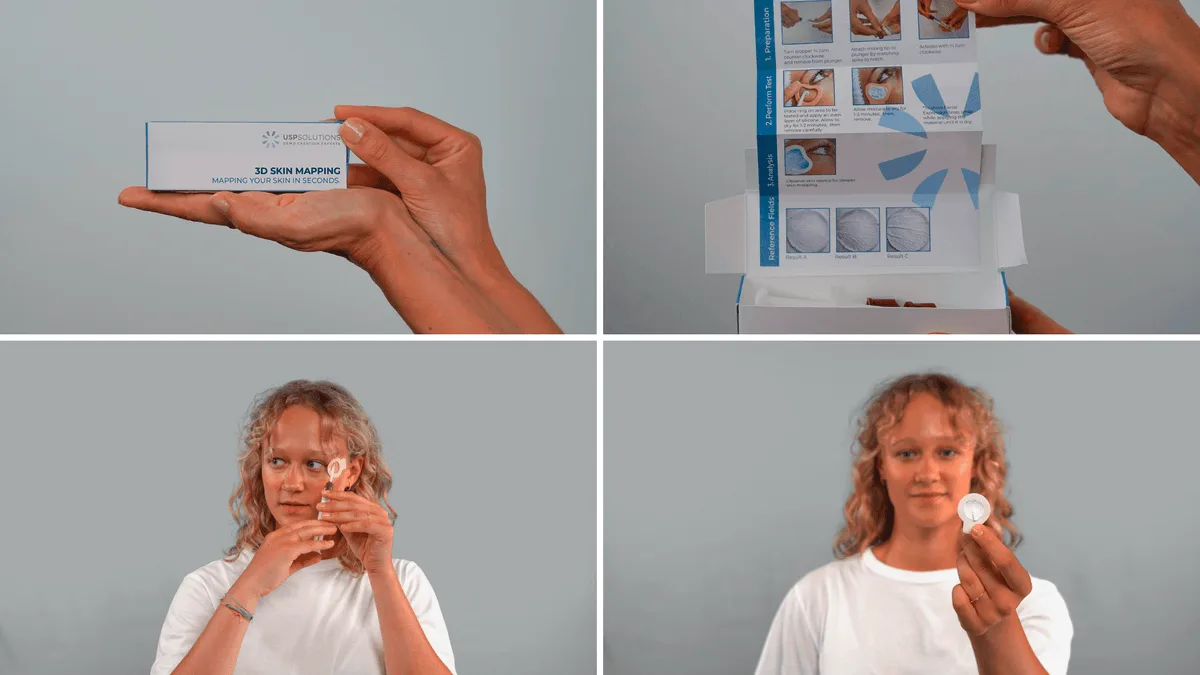
What it offers is simple and compelling. A quick application of the demo patch onto the skin creates a high-fidelity 3D imprint, capturing everything from fine lines and pores to surface texture and overall condition. In less than a few moments, users have a clear, physical replica of their skin with striking clarity that can be analysed on the spot.
For brands, this means an ultra-precise product recommendation tool, that opens a conversation with their consumers to communicate what their products do.
Diego Kanda-Diwidi, CEO of USP Demo Solutions, sees it as a timely innovation.
“Consumers are tired of being told what a product can do. They now want to see what it does.”
“The 3D Skin Mapping Tool gives brands the ability to show real results, instantly. It’s one of the most honest pieces of technology we’ve built and in today’s beauty market, that kind of transparency builds real loyalty,” he said.
The tool has been designed for ease of use, may it be at retail counters, livestream broadcasts, clinical trials or expert panels. It requires no training and delivers results that are both instantly visible and scientifically relevant.
For influencers and KOLs, it’s a credibility goldmine. Offering brands a powerful new way to tell their story. While at the same time supporting claims and demonstrating results in product launches, retail environments, and clinical studies. Whether it’s anti-aging formulas, resurfacing treatments, or hydration boosters, the before-and-after effect is no longer something consumers need imagine.
What separates this tool from the rest is that while other skin analysis systems rely on software or image interpretation, this tool stays grounded in tactile, visual evidence.
For an industry that thrives on credibility but often lacks tangible evidence, the 3D Skin Mapping Tool is a shift in how beauty brands can connect with their consumers. It offers a new level of clarity, not just on the skin but in the message being delivered. And as Diego puts it, “Demonstration is our language, this tool lets the skin speak for itself.”
Where 3D skin mapping fits next
The next wave of 3D skin mapping rollouts is moving beyond the beauty counter. Dermatology clinics are using the patches to document patient progress between appointments without relying on subjective scoring; influencer-led livestreams use them to give viewers an unedited reference point that survives a screenshot; and brand R&D teams use the imprints as a tactile artefact in stage-gate reviews, where leadership can literally feel the difference an active ingredient is delivering.
Because each patch is a physical object, the data does not vanish when the screen turns off. Brands archive imprints alongside trial photography, regulators get a tangible record they can re-examine, and consumers walk away with a memento that quietly reinforces the claim every time they pick it up. That long tail of tactile proof is where 3D skin mapping starts to differentiate itself from purely software-based diagnostics, and it is why we expect the format to keep spreading across personal care over the next two years.
How brand teams can deploy 3D Skin Mapping
The practical move for brand teams interested in 3D Skin Mapping is to pilot it in one high-evidence environment first, a clinical trial, an expert panel, or a flagship counter, before scaling to creator content or sampling kits. Piloting in a controlled setting lets the team learn what good imagery looks like, what reading protocol works for non-experts, and how to talk about the result in plain language. Those lessons travel directly into the broader rollout and dramatically improve the quality of the imagery that reaches consumers.
Once the pilot has produced a clean playbook, the same demo can flex across livestream, retail counter, training and influencer use without re-engineering. The key is to keep the protocol identical across channels, so a consumer who sees a creator's reading and then has their own taken at counter recognises the result as the same evidence. That consistency is what turns a striking piece of technology into a durable brand asset, rather than a one-off launch moment that fades after the press cycle.