
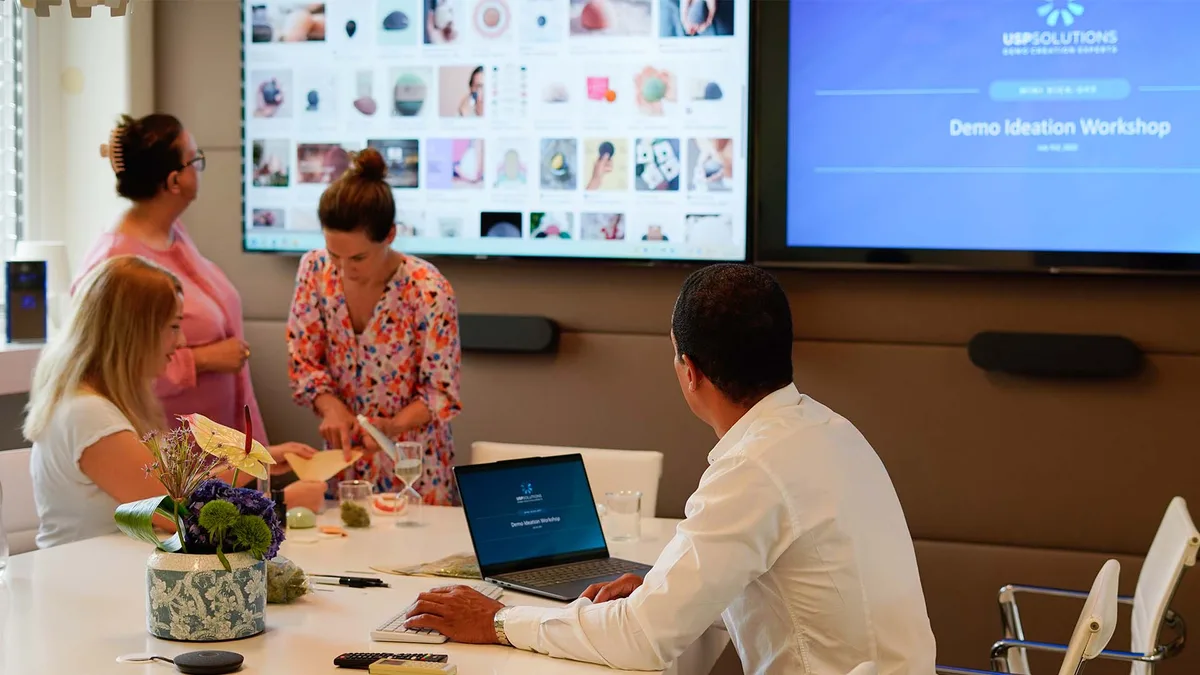
In this article: how a new Demo Innovation Workshop is helping R&D leaders translate complex science into a story that communicates clearly to executives and cross-functional partners - a press-release-style update on the format that R&D leaders can use internally to brief executives and cross-functional partners on new lab work.
Audience focus: this article is written for R&D directors, VPs of Innovation and CTOs who need a structured internal process for explaining new innovation to executives, regulators and cross-functional partners. For a marketing-led perspective covering campaign integration, see marketing storytelling for science-led brand launches; for the consumer-facing translation layer, see building lab-to-shelf consumer demos.
With innovation cycles speeding up and proof points getting harder to defend internally, R&D teams are under continued pressure to brief executives, regulators and cross-functional partners clearly and convincingly before any external rollout begins.
Product science doesn’t speak for itself. It’s complex, often invisible, and usually gets lost in translation between R&D and the rest of the world. Technical teams might fully understand the innovation, but they often struggle to sell the idea to senior business leaders who aren’t technical; or communicate the benefits so the consumer can truly understand its advantages. Especially when the claims are new, technical, or hard to picture.
Building upon this need along with our years of experience developing high-impact, science-driven demo tools, the Demo Innovation Workshop was created.
This new hands-on format is designed for R&D teams that need to translate what’s happening at the lab into something that decision-makers, marketers, and consumers can understand. The workshops are conducted in person, either as one-time sessions or recurring events, and focus on rapid collaboration. Teams work directly with USP’s demo creation specialists to co-develop functional, scalable demos that bring product benefits to life visibly, instantly, and memorably.
Diego Kanda-Diwidi, CEO of USP Demo Solutions, explains, “A good product demo must make the audience believe in how and why the product works and matters. Our workshops help teams move faster to turn complexity into clarity and build demos that speak for their science.”
With more than 2500 projects successfully completed with over 480 brands around the world, the team behind this approach knows what it takes to bridge the gap between product science and actual impact.
To see some real-life examples of what this looks like, visit usp.at/demo-library. For details about the workshops, go to usp.at/solutions.
For inquiries or to schedule a discovery call, visit usp.at/contact.
How R&D teams can apply this
For R&D leaders, the practical shift is to treat the demo as a deliverable of the project, not a marketing afterthought. Add a demo brief alongside the technical dossier at the formulation freeze stage, so the visual proof is designed while the science is still being defended internally. That single change forces the team to articulate, in plain language, what the molecule actually does and what a non-scientist would have to see to believe it.
A useful next step is to build a short internal library of "one-slide demos": for each platform technology your lab owns, capture one repeatable, visible experiment that proves the mechanism in under 60 seconds. These become your reusable assets across pitches, sales training, regulatory conversations and consumer activations. Over time, this library becomes a quiet but powerful translation layer between the lab and the rest of the business, and it dramatically reduces the rework that happens when marketing tries to invent a story the science cannot support.
A final habit worth building is to pair every new platform technology with a named "demo owner" inside R&D. That person is responsible for keeping the one-slide demo current as the science evolves, so the rest of the business is never working from a version that is six months out of date. It is a tiny operational change with a disproportionate impact, because it stops the slow drift that otherwise creeps into how the brand talks about its own science.