
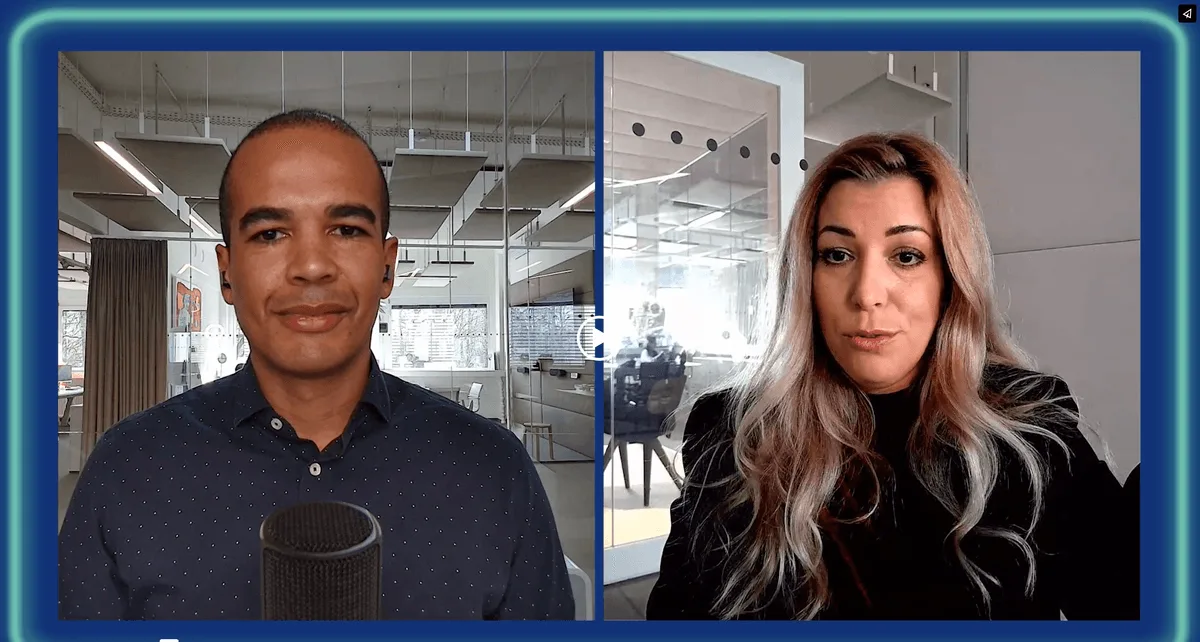
In this article: an episode of our Beyond the Lab series in which Alma Alibegovic discusses today’s biggest cosmetics industry challenges and the role of credible product demos in solving them across the wider industry.
Alma Alibegovic has spent her career at the intersection of formulation science, regulation and brand storytelling, and that perspective makes her one of the most direct voices on what is genuinely hard in cosmetics right now. In this Beyond the Lab conversation she works through three pressure points she sees in nearly every brief: shrinking trust in claims, the speed of social proof, and the rising bar for ingredient transparency.
Trust in claims
Consumers no longer take a percentage on a pack at face value. Alma argues that claims now need to be paired with something the shopper can see, hold or test for themselves which is exactly the gap a well-designed demo fills. A diagnostic card, a sensory tester or a phygital reveal turns a number into an experience.
The speed of social proof
A creator can dismantle a brand promise in a 30-second video before the marketing team has had its morning coffee. The defensive answer, Alma says, is to make sure the same product story stands up to a hand-held demo by anyone, anywhere. If your demo works in a creator’s bathroom, it will work in a Sephora aisle too.
Ingredient transparency
Modern cosmetics buyers want to know not just what is in a formula but why it is there and what it does. Demos that visualise mechanism of action how an active reduces sebum, hydrates the stratum corneum, or shields against UV bridge the gap between an INCI list and a benefit.
For a complementary perspective from another USP voice, see our episode What is a Demo? with Niccolò Palazzoni.
How brand teams can act on this
For brand teams in cosmetics, the practical next step is to separate the challenges that are real from the ones that are inherited. Sit with your last twelve months of launches and sort the friction points into two buckets: structural issues that the category creates, and self-inflicted issues that come from how the brief was written. Most teams discover that more than half of their pain is self-inflicted, which is good news because that half is fixable without waiting for the market to change.
From there, pick the single issue that costs you the most time and money, almost always either claim substantiation or repeatable demo execution, and run a 90-day sprint focused only on that one problem. Bring R&D, regulatory, brand and a demo partner into the same room, write down the working definition of "solved", and refuse to widen the scope. Categories move forward by closing one problem at a time, not by trying to redesign everything in a single cycle.
It is also worth sharing those wins openly inside the business. Many cosmetics teams have solved a specific challenge in one market or one launch and never documented it, so the next team to face the same issue starts from scratch. A simple internal habit, a short written case study after every meaningful demo or claim project, turns isolated wins into institutional knowledge and quietly accelerates the rest of the portfolio over time.
The other practical step is to bring partners into the conversation earlier. Many cosmetics challenges sit at the boundary between the brand and its suppliers, contract manufacturers, regulatory consultants, demo specialists, and they only get solved when those partners are briefed as collaborators rather than vendors. A short joint working session at the start of a project, instead of a sequence of one-way briefs, usually surfaces the constraints that would otherwise emerge late in development and force expensive rework.