
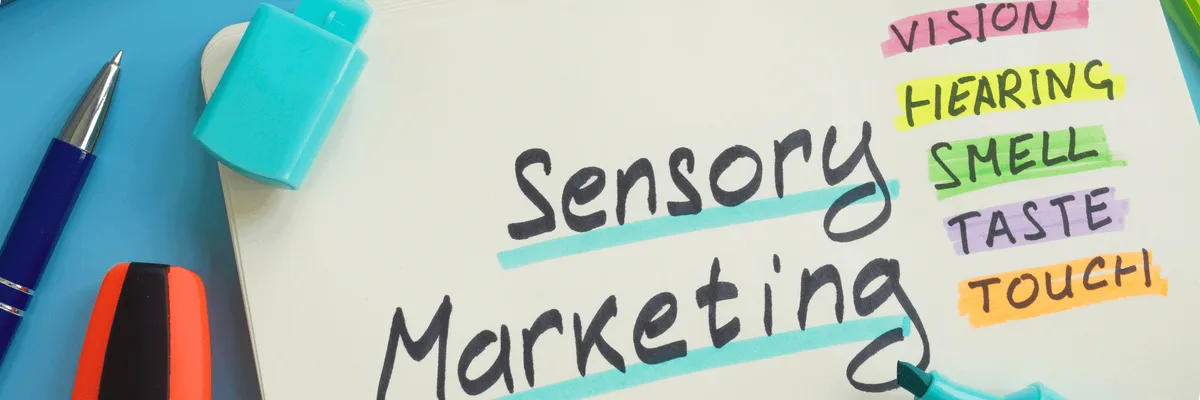
In this article: a short response to Harvard Business Review's "The Science of Sensory Marketing" - and what its findings on non-conscious consumer stimuli mean for CPG product and brand teams thinking about the next category of innovation.
This is a brief commentary on a single piece of secondary research - HBR's "The Science of Sensory Marketing" - rather than a primer on the discipline. It exists because the article's framing of non-conscious stimuli changes how CPG teams should be briefing demo and design work, and that shift is worth pulling out separately.
The HBR article explores how academics are becoming increasingly interested in sensory input and its relation to marketing, and suggests that we are about to witness a surge in consumer product companies utilizing this technique.
Marketing researchers are “starting to realize how powerful the responses to nonconscious stimuli can be,” says S. Adam Brasel, an associate professor of marketing at Boston College. One particularly noteworthy fact mentioned in the article is that a recent Association for Consumer Research North American conference set a record for papers presented on sensory marketing.
While some types of companies, such as hospitality, food, and cosmetics, have embraced the power of sensory marketing for years, others have remained focused on visual attributes. The article points out that things are about to change as a more diverse set of managers discovers the benefits.
The article concludes that if they wish to be on the leading edge of innovation and marketing, every consumer company should be thinking about design in a holistic way that utilizes the senses.
As a global leader in sensory marketing tools, USP Demo Solutions has provided beauty brand activation solutions for cosmetic companies in more than 70 countries. Take advantage of their know-how and request a free brand activation check.
How to design a more sensory demo
To translate the role of the senses into a real demo, treat each sense as a checklist item in the brief rather than as a creative flourish at the end. For every hero claim, ask what the consumer should see, what they should feel on the skin or in the hand, what they should hear from the application, and what they should smell. Demos that consciously engage three or more senses are dramatically more memorable than demos built only around a visual effect, and the additional cost is usually small.
The next time you brief an activation, write the sensory layer into the protocol itself. Specify the texture of the applicator, the temperature of the surface, the sound of the foam or pump, and the scent profile of the test product. Train the staff or creator to draw attention to each of these moments out loud. This is how counter-based prestige brands have driven conversion for decades, and the same playbook now translates directly into livestreams, sampling kits and creator content, where the sensory layer carries through to the camera and the audience.
It is also worth investing in the recovery side of the sensory experience, what consumers remember after they leave the activation. A small, well-designed take-home, a sample wrapped in a tactile material, a scent strip, a card with a texture detail, extends the sensory memory by days or weeks. That extended recall is what drives the second visit to the brand site, the conversation with a friend, and ultimately the first purchase. Sensory marketing is not a one-shot experience; it is a slow-release asset that keeps working long after the activation is over.
The wider point is that sensory marketing is not a luxury reserved for premium brands. The cost of engaging an additional sense at a touchpoint is almost always trivial relative to the lift it produces, which means mass-market brands have at least as much to gain as prestige ones. Building a simple internal habit, "name the senses" in every brief, is one of the cheapest and most reliable ways to raise the floor on activation quality across an entire portfolio.