
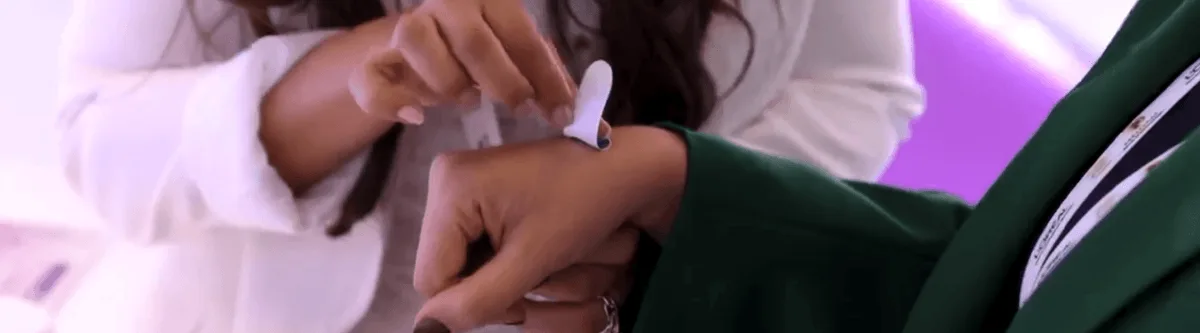
In this article: lessons B2B brands can learn from how food marketing demos product performance.
Food marketing has mastered something many technical industries still struggle with: making product performance instantly understandable. The lessons travel directly to B2B demos.
Walk through any supermarket and you will see it everywhere. Fresh bread being cut. Cheese melting on a hot pan. A sauce poured over pasta. Within seconds, consumers understand the product’s quality, texture, and appeal.
No complex explanation required.
This is the power of demonstration.
Interestingly, the same principle applies perfectly to science-driven B2B products.
Many industries, from skincare to hair care, oral care, medical devices, and materials science, rely on technologies that are scientifically complex. These innovations are often communicated through data sheets, technical presentations, and long product claims.
While scientifically correct, this approach often fails to create immediate understanding.
People rarely remember slides full of graphs.
But they remember what they can see, feel and understand.
Why Demonstrations Work
Food demos succeed because they simplify information into a clear visual story. The audience immediately understands the transformation.
Raw ingredients become a finished dish.
Hard cheese melts smoothly.
A sauce thickens while cooking.
Within seconds, the product benefit becomes obvious.
The same storytelling structure can be applied to scientific product innovations.
Translating Complex Science into Visual Proof
At USP Demo Solutions, this is exactly where demonstrations become powerful communication tools.
Our work focuses on translating complex product science into simple, visual proof points that can be used across multiple touchpoints, from internal training to global product launches.
This can include:
• Short science-based videos for internal training
• Phygital demos combining physical setups with digital layers
• AI-supported visualizations that simplify mechanisms of action
Instead of explaining a technology in ten slides, a strong demo can often communicate the same idea in twenty seconds.
Why the Demo Approach Matters Today
Today’s audiences, whether internal teams, retail partners, or healthcare professionals, are overloaded with information.
Time is limited, attention spans are short, and technical complexity continues to increase.
This is exactly why demonstrations become so valuable.
They turn complex explanations into intuitive understanding.
Food brands have used this principle for decades to show freshness, taste, and quality.
For science-driven B2B companies, the opportunity is similar.
When product science becomes visible, tangible, and easy to grasp, innovation becomes easier to communicate, easier to train, and easier to sell.
Sometimes the most effective explanation is not a slide deck.
It is simply showing how it works.
What B2B teams can borrow tomorrow
The translation from food demo to B2B demo is more direct than most teams expect. Pick the single claim your buyer keeps asking about, look for the food-aisle equivalent freshness, ripeness, heat, freshness-after-freezing and reverse-engineer the cue that sells it in three seconds. The cue can be a colour change, a temperature shift, a side-by-side comparison or a tactile contrast. The point is to remove the cognitive effort needed to believe the claim.
For science-led B2B brands the payoff is twofold. Sales conversations move faster because the proof lands before the buyer has to read a spec sheet, and internal alignment improves because R&D, marketing and commercial all see the same physical artefact. The next time a launch deck feels like it is doing too much heavy lifting, ask whether a small, food-style demo could carry the weight instead.
How to borrow the food playbook in B2B
The practical way to apply the food-marketing playbook to a science-led B2B product is to replace your next data-heavy slide with a single physical demonstration that the audience can witness or participate in. If the claim is "reduces friction", show two surfaces side-by-side and let the customer drag a finger across each. If the claim is "absorbs faster", run a pipette test on both samples in front of the room. The drama is not theatrical, it is evidential, and it lands in a way no chart ever does.
From there, build a small library of repeatable, food-style demos for your top three product platforms. Each demo should take under 60 seconds, work in any meeting room, and be reproducible by a sales engineer with no specialist training. Once that library exists, sales conversations, trade-show appearances, customer site visits and webinars all draw from the same proof points, and the brand starts to acquire the same instant-recognition advantage that strong food demos enjoy on shelf.