
In this article: how USP's Demo Upskilling Workshops turn technical claims into demonstrations teams can use across launches, retail, and influencer campaigns.
Bringing together R&D, claims, innovation, and marketing teams, our Demo Upskilling Workshops are designed to help organizations rethink how they communicate product benefits.
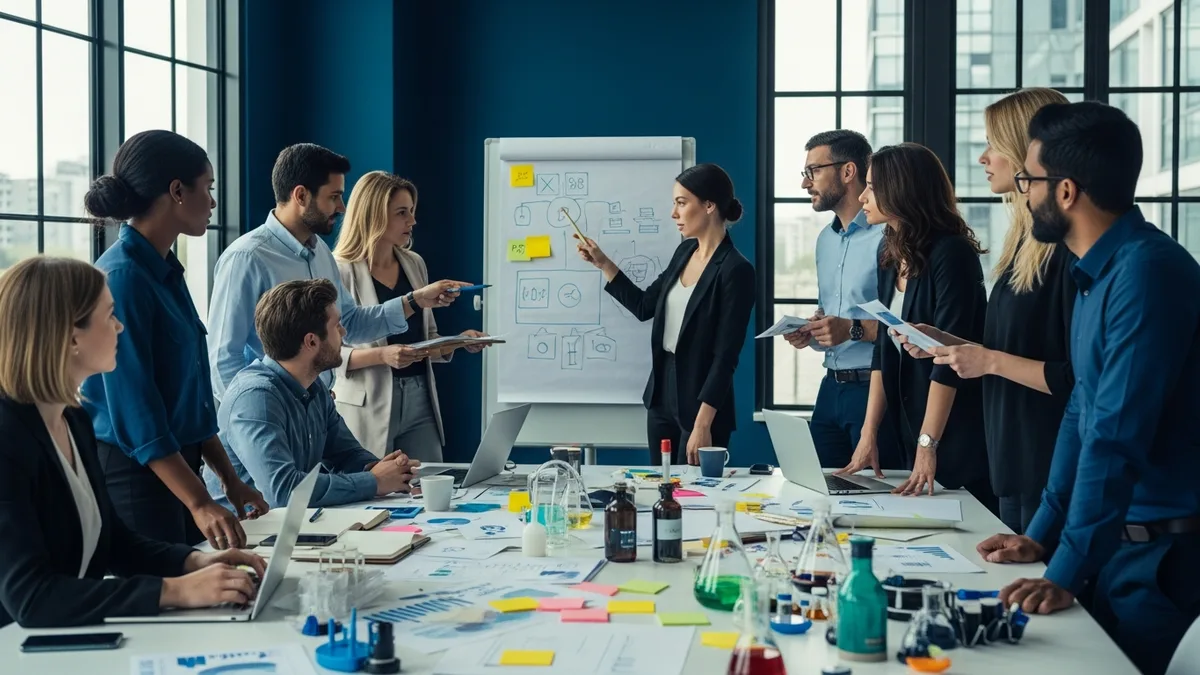
These are not training sessions where science is discussed in abstract terms. Inside each workshop, participants work hand in hand with USP to transform technical claims into clear, engaging demonstrations that can be used across product launches, influencer campaigns, retail environments, and internal stakeholder presentations.
The goal is simple: make your science visible.
A Workshop Focused on Action Rather Than Just Conversation
These workshops are highly interactive and structured around three key stages.
The first session focuses on building a shared understanding of what makes a great demo, exploring why demos have become essential tools for creating trust, how audiences process proof, and what separates a memorable demo from a forgettable one.
From there, it shifts from theory to application. Through real-world case studies and live examples, participants experience different demo formats, including physical, digital, live, and phygital demonstrations. They learn how successful demos are developed, validated, and deployed across different channels and markets.
The final stage is where the workshop becomes truly collaborative. Our aim is to provide guidance, input, and inspiration on how to solve their demo challenges. Teams bring forward their own innovation challenges and product claims. Together, we explore opportunities, challenge assumptions, test ideas, and evaluate feasibility. Participants leave with tangible concepts, a more defined plan, and a new outlook on how to communicate science.
What makes the format work is the mix of people in the room. When R&D, regulatory, claims, innovation, and marketing sit at the same table, the conversation moves beyond what a product does and into how that benefit can be seen, felt, and trusted. Each function brings a different test for an idea, and the concepts that survive all of them tend to be the ones worth building. That shared scrutiny is hard to recreate in day-to-day work, where teams usually review claims in isolation rather than side by side.
The Ideas That Emerge
One of the most exciting aspects of these workshops is seeing how quickly teams begin to think differently.
A claim about skin barrier protection may evolve into a visual demonstration that allows audiences to see damage prevention in real time. Or a microbiome-related innovation might inspire a simple visual metaphor that makes a complex scientific concept immediately understandable.
Across categories, teams move away from describing benefits and start designing proof experiences that audiences can understand. Often, the strongest ideas come from combining perspectives across functions, with R&D contributing scientific rigor and marketing shaping audience relevance.
The biggest outcome of these workshops is not a single demo concept. It is a mindset shift.
Participants gain a new way of thinking about innovation communication. They learn to evaluate claims through the lens of demonstrability, identify opportunities earlier in the development process, and build stronger collaboration between technical and commercial teams. Many organizations leave with not only validated demo ideas, but also a repeatable framework for their markets.
As consumer attention becomes harder to earn and trust becomes more important than ever, the ability to translate science into visible proof is becoming a strategic advantage. Our Demo Upskilling Workshops help teams build that capability, ensuring that great innovations do not just exist in the lab, but come to life in ways that every audience can immediately understand and believe.
By the end of a session, teams are not just talking about better communication. They are holding early demo concepts, a clearer sense of which claims are worth demonstrating first, and a shared language for evaluating proof. That is the real value of the workshop. It turns an abstract ambition, making science visible, into a concrete plan the whole organization can act on long after everyone has left the room.
If you want to see how a session is structured and what your team would walk away with, explore the full workshop programme.