
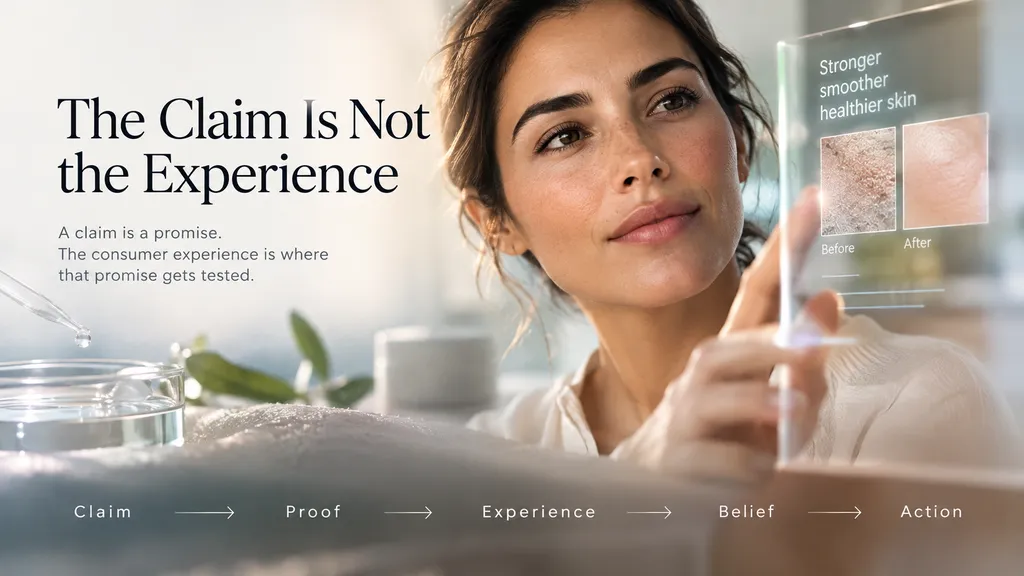
A claim is essentially a promise. A promise the brand makes to the consumer.
It tells us what a product is supposed to do, what benefit it delivers, or what makes it different. Behind that claim there may be years of research, testing and product development. In many cases, the science is solid.
But there is still a gap between a claim being true and a person believing it. This gap is where I think consumer experience has a much bigger role to play than it is often given.
In our industry, we spend a huge amount of time developing and communicating claims. We invest in research to establish efficacy, work hard to substantiate the benefit and then find increasingly sophisticated ways to communicate it.
What often gets less attention is what happens when the claim reaches the consumer.
For example, a skincare product might claim to improve hydration. The science behind it may be compelling, but the consumer is still being asked to take that information at face value. They can read about the mechanism, see the clinical results and hear about the ingredients, but none of that necessarily gives them a personal understanding of what the benefit actually means.
Give them a way to experience the difference, however, and something changes.
The claim has not changed nor has the science or evidence.
The relationship between the person and the claim has changed.
Making the invisible tangible
This becomes particularly interesting with product benefits that are difficult to see.
Hydration, absorption, friction, softness, protection, surface changes and ingredient performance are all things that can be scientifically measured without necessarily being obvious to the person using the product.
The traditional response is to explain them.
We use language, imagery, statistics, demonstrations and increasingly sophisticated digital content to make complex benefits easier to understand. These tools are valuable, no doubt, but there is a limit to how much information can do on its own.
Sometimes the better approach is to make the underlying effect tangible.
That does not mean turning science into entertainment. Quite the opposite. The science has to remain the foundation. The experience should be a credible translation of what is actually happening, not a visual trick designed to make a product look more impressive than it is.
This is where demonstration design becomes much more than creating something that attracts attention.
A good demonstration does not simply illustrate a claim. It gives people a way to understand the evidence behind it.
From proof to experience
Once the science is understood, there are often more possibilities than simply communicating the result.
The interesting part is whether the experience makes the product benefit easier to understand and believe.
That distinction matters because there is no shortage of interactive experiences that create engagement without necessarily creating understanding. An experience can be entertaining, visually impressive and highly shareable while still leaving the original claim exactly where it started.
The strongest experiences have a much clearer job to do.
They connect the product truth to something the person can experience for themselves.
Belief is different from awareness
There is a significant difference between knowing that a product makes a claim and believing that the product can actually deliver it.
That difference becomes particularly important as product science becomes more sophisticated.
Consumers are increasingly exposed to claims around complex ingredients, mechanisms and performance. Brands are communicating more technical information, yet more information does not automatically mean more understanding.
Experience can provide another route into the science.
Being told that a formulation absorbs quickly is one thing. Seeing or feeling how it behaves compared with another formulation creates a different kind of understanding.
The information has not necessarily become simpler. It has become more tangible.
And once something is tangible, it can become personal.
That is often where belief starts to develop.
From belief to action
The journey from claim to consumer action is rarely as simple as seeing an advertisement and making a purchase.
There are usually several stages in between. A person has to notice the benefit, understand it, find it relevant and believe that the product can deliver it.
Experience can play an important role in that middle ground.
It can turn a product benefit from an abstract statement into something that feels relevant to the individual. That experience might happen in a store, at an event, during a product launch, through a creator, within a digital activation or even as part of a sales or training environment.
The context changes, but the underlying principle remains the same:
Claim → Proof → Experience → Belief → Action
Each stage builds on the one before it.
The claim establishes the promise. Proof gives the promise credibility. Experience makes that proof tangible. Belief creates confidence in the benefit. And confidence makes action more likely.
Of course, not every claim needs this treatment. Some benefits are clear enough to communicate directly. Forcing every product story into an interactive experience would be just as ineffective as relying on claims alone.
The skill lies in recognising where experience can do a job that communication cannot.
Experience should not be an afterthought
This is perhaps the biggest opportunity for brands.
Experience is often treated as the final layer of communication. The product has been developed, the claims have been established, the campaign is taking shape and then someone starts thinking about how to bring the story to life.
By that stage, the possibilities can be limited.
Bringing experience thinking further upstream changes the process.
When product development, R&D, innovation and marketing teams consider the eventual consumer experience alongside the product benefit, the science can be translated in much more interesting ways.
A technical result might become a sensory experience. A clinical benefit might inspire a comparison. A complex mechanism might become an interactive explanation. A personalised result might become the basis of a digital experience.
The experience is no longer something added to the claim.
It becomes part of how the claim is understood.
The claim is only the beginning
The real opportunity lies in creating a credible bridge between what the brand says and what the consumer can understand, see, feel or experience.
That requires a close connection between product science, evidence and experience design.
When those three come together, something more powerful happens. A product benefit stops being just a statement and becomes something the consumer can relate to personally.
That is the journey from claim to proof, from proof to experience, from experience to belief, and ultimately from belief to action.
The claim makes the promise.
The experience gives people a reason to believe it.